

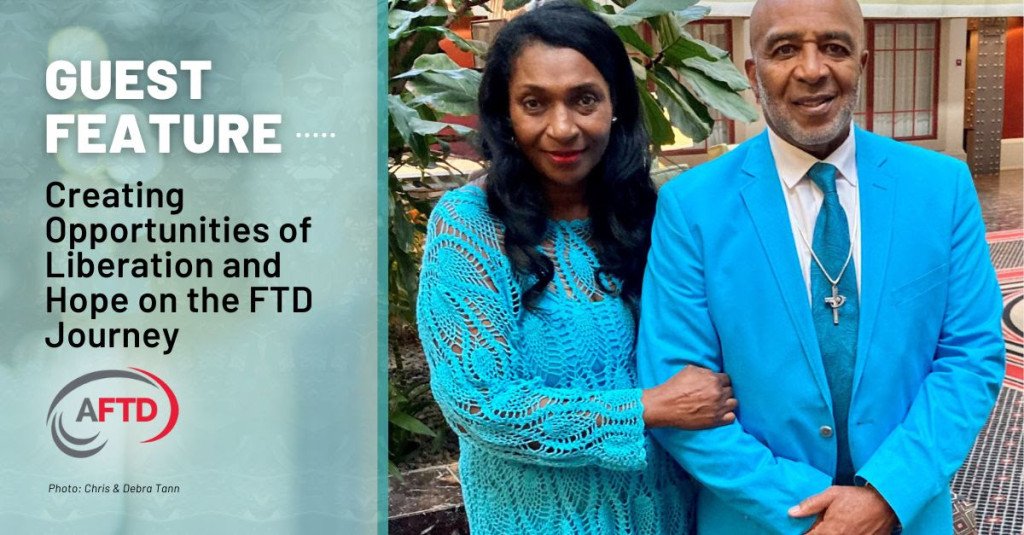
Living with FTD is difficult for families due to its distressing symptoms and the sweeping life changes that are often required to adapt to them. Families often find that there is little support for those affected by FTD because not enough people know about it. Chris Tann, who is currently living with FTD, and Debra, his wife of 35 years and care partner of 9 years, recently sat down with AFTD to share their lived experience and offer advice for families living with FTD and other dementias. The couple believes they have a responsibility to educate people about FTD to help enhance the lives of those on the FTD journey.
“I think people should be more interested in learning about dementia because it’s very prevalent in the world,” Chris said to AFTD. “One of the major things we need to do is get this information out to everyone. Regardless of where they are, how they received it — not everybody is going to be on Zoom or looking online.”
Finding Support
FTD’s symptoms create unique challenges, but Chris told AFTD that he has been handling his diagnosis well. However, he said getting diagnosed was a journey with its own difficulties. The first signs began to show in 2015 as behavioral changes, such as Chris leaving things in odd places. Chris said, “I’m not the only one who lives in the house, so I didn’t think it was me. My wife said it was, so I just went with that.” Acknowledging what Chris said, Debra said he was not able to recognize his dementia and limitations, an FTD symptom called anosognosia.
When she first noticed the changes in Chris, she did not know much about FTD, Debra said. “But what I did know was two things: one, this was medical — I had no idea how, but I just knew. Two, because it was medical, I had to be in for the long haul, but I didn’t know what I was contending with.”
Chris initially sought help at Mayo Clinic, where he spent hours participating in screenings before receiving an initial diagnosis in 2017 of mild cognitive impairment (MCI). His physician prescribed medication that caused him not to feel like himself and made it hard for him to function at work. Because of this, Chris and Debra decided to find a second opinion.
After two years of uncertainty, they finally found availability at the FTD clinic at Vanderbilt University, where Chris was diagnosed with FTD. They were fortunate that Debra found a highly knowledgeable local neurologist in rural southern Georgia. After two years of health care for Chris and engagement with Debra, she diagnosed him with FTD in 2019. While thankful for an answer, their relationship was short lived, as Chris’ neurologist relocated her practice. According to Debra, “she was God sent.”
The journey continued for Chris and Debra, but now they had a formal diagnosis of FTD. Debra again searched the literature for a neurologist. She found a neurologist at the FTD Clinic at Vanderbilt Clinic. The doctor at Vanderbilt understood FTD, Debra said. “He did his battery of testing and was very assertive and knowledgeable. It was a blessing to run into her in rural South Georgia.” Although the drive to the clinic took seven hours, Debra said getting Chris to a specialist who was knowledgeable about FTD was worth it. “[FTD] is so unique and is often misunderstood, so I needed him in the most capable and competent hands possible.” And for others who may be searching for a diagnosis, Debra strongly recommends searching for availability at research hospitals.
Education Is Key
Debra eventually discovered a support group called Black Dementia Minds, which is associated with the National Council of Dementia Minds. The group acknowledges that everyone who has dementia experiences it differently, and that it is important for Black/African American individuals with a diagnosis to have a space to seek support from one another.
“[Black Dementia Minds] is a beautiful family,” Chris said. “We call ourselves a family because there are different people with different dementia types, and we can discuss, relate, and understand each other and what we’re going through.” He and many members of the group also take part in advocacy, speaking digitally at venues like colleges and sharing what it is like to live with dementia.
“We think it’s a beautiful thing because we’re able to talk to people,” Chris said. And the audience enjoys the presentations, because “they’re able to talk to someone who is actually living with dementia and who can explain things.”
Chris’ dedication to advocacy goes beyond his work with Black Dementia Minds. He and Debra told AFTD their faith provides support as they navigate FTD, and Chris talked about drawing on his personal relationship with God as a source of strength. He also discussed working with Alter, an organization dedicated to working with faith communities to create inclusive, dementia-friendly environments. Chris met Alter’s founder, Fayron Epps, PhD, RN, through Black Dementia Minds and went on to speak at the organization’s summit.
Debra agrees with Chris about the importance of advocacy, and she underscored the significance of education overall. “Education is the key,” she said. “My life’s work in this space is to educate. As a dementia care partner, advocate, and educator – wherever I am and whatever audience I have the privilege to engage with, I make sure that I recognize and underscore that all dementia diseases are important.”
She also stressed the importance of self-care for care partners. “Caregivers and care partners endure an enormous amount of responsibilities,” Debra said. “Candidly speaking, being a FTD carer is not easy, which is why a care team for Chris is [essential].” She went on to say she has an obligation to “take supreme care of myself.” Indeed, Debra encourages all care partners to practice mental, social, financial, physical, emotional, and spiritual self-care, and said, “These domains create opportunities of liberation to live a life of hope on the FTD journey.”
Dr. Debra Tann is recognized by the Southern Gerontological Society for her commitment to caregiver advocacy and the lived experience.
Must Log in to Linked in to read.